Blog
Discover what Answer Engine Optimization (AEO) means and why it’s replacing SEO as the key to brand visibility in AI search. Learn how GoxygenAI helps businesses become the go-to answers for ChatGPT, Google Gemini, and beyond.
Discover what Answer Engine Optimization (AEO) means and why it’s replacing SEO as the key to brand visibility in AI search. Learn how GoxygenAI helps businesses become the go-to answers for ChatGPT, Google Gemini, and beyond.
How AEO Is Revolutionizing Brand Visibility in 2025 | GoxygenAI –purple: #3b00ad; –text: #0f1724; –muted: #6b7280; –bg: #ffffff; –surface: #fbf9ff; –border: #e9e6fb; –radius: 12px; –container: 1100px; –shadow: 0 12px 34px rgba(30,10,80,0.08); } html,body{margin:0;padding:0;background:var(–bg);color:var(–text);font-family:Inter,system-ui,-apple-system,Segoe UI,Roboto,’Helvetica Neue’,Arial;} .container{width:min(var(–container),94%);margin:0 auto;padding:2rem 0} header.site-hero{background:linear-gradient(180deg, #fff, #fbf8ff);padding:3.2rem 0;border-bottom:1px solid var(–border)} .brand{display:flex;align-items:center;gap:.8rem;font-weight:800;color:var(–purple)} .brand .dot{width:14px;height:14px;border-radius:50%;background:var(–purple);display:inline-block} header h1{font-size:clamp(1.6rem,3.8vw,2.6rem);margin:.6rem 0 0} header p.lead{color:var(–muted);margin-top:.6rem;font-size:1rem;max-width:70ch} article.main{background:linear-gradient(180deg,#fff,#fbf8ff);padding:2rem;border-radius:16px;margin-top:1.6rem;box-shadow:var(–shadow);border:1px solid var(–border)} article h2{color:var(–purple);margin-top:1.6rem} p{margin:0 0 1rem 0} blockquote{border-left:4px solid var(–purple);padding-left:1rem;color:#444;font-style:italic;margin:1rem 0} ul{margin:0 0 1rem 1.2rem} ol{margin:0 0 1rem 1.2rem} .callout{background:var(–surface);border:1px solid var(–border);padding:1rem;border-radius:10px;margin:1rem 0} .cta{display:inline-block;background:var(–purple);color:#fff;padding:.8rem 1.2rem;border-radius:999px;text-decoration:none;font-weight:700;margin-top:1.2rem} footer.site-foot{margin-top:2rem;padding:2rem 0;background:#f7f7ff;border-top:1px solid var(–border);text-align:center;color:var(–muted)} .meta{font-size:.9rem;color:var(–muted);margin-top:.6rem} .small{font-size:.95rem;color:var(–muted)} pre{background:#fff;padding:1rem;border-radius:10px;border:1px solid #efeffb;overflow:auto} @media (max-width:800px){ .container{padding:1rem} article.main{padding:1rem} header p.lead{max-width:100%} } GoxygenAI How AEO Is Revolutionizing Brand Visibility in 2025: The Rise of Answer-Ready Marketing A practical, no-fluff guide that explains what Answer Engine Optimization (AEO) is, why it matters now, and the exact steps brands must take to become the answers AI systems cite across ChatGPT, Google Gemini, Perplexity and voice assistants. Published: 2025 • Length: ~2,200–2,500 words • By GoxygenAI “When people used to search, they got links. Now they get answers.” — and that single shift is rewriting the entire playbook of digital visibility. The Search Game Has Changed Forever Until very recently, the path to visibility was fairly predictable: optimise your site, rank on Google’s page one, drive traffic. That model still matters — but it’s no longer sufficient. The way people discover information is changing, fast. A growing percentage of queries are being answered inside AI interfaces — not on a list of links. Users ask questions and AI systems summarize, recommend, and decide. In short: people aren’t just searching anymore — they’re asking. And the platforms that answer those questions are increasingly the first interface between brands and customers. Recent studies and industry reports show that AI-driven search and conversational assistants are being used daily by a substantial and growing portion of consumers. As these interfaces mature, they increasingly provide direct answers rather than lists of pages, which means traditional click-through traffic patterns change. Being visible in the AI answer is now a distinct and valuable form of visibility. What Exactly Is AEO? Answer Engine Optimization (AEO) is the strategic practice of structuring, optimizing, and presenting content so that AI-powered answer systems recognise, trust and cite your brand as the go-to answer when a user asks a question. It is not a rebrand of SEO — it’s a different objective: selection rather than rank. AEO focuses on four core things: Question intent: understanding the exact natural-language queries people use. Short, authoritative answers: concise snippets that AI can extract easily (typically 40–60 words). Structured content and schema: machine-readable signals (FAQ, HowTo, Article schema) that make your page easy to parse. Authority signals and entity clarity: clear branding, authorship, citations, and cross-domain mentions that establish credibility. Why AEO Matters Now — And Why You Can’t Wait The shift toward AI-first discovery is already well underway. Major platforms are embedding generative AI summaries into search results, conversational agents are becoming default discovery tools, and voice assistants are increasingly relied upon for immediate answers. What was once experimental is now a primary point of contact. If your brand is not prepared for this reality, you will not just lose clicks — you will lose the association. When AI systems use competitor content to answer queries, your brand misses both the impression and the implicit endorsement built from being cited. Being chosen by AI systems brings awareness, trust, and downstream conversions in a way that simple ranking cannot replicate. Brand risk: When AI picks answers from a small number of sources, those brands become default authorities. If you don’t appear there, your audience will learn about competitors first — and trust them more. Six Practical Strategies to Win with AEO Below are the research-backed tactics and operational steps that produce measurable results in AEO programs. 1. Map Real Conversational Questions (Start with Intent) The most important foundation of AEO is a thorough map of the exact questions your audience asks in natural language. These are not tidy keywords — they are conversational queries: “How do I choose a content marketing agency for AI visibility?” not “content marketing agency.” Tools and signals: use AlsoAsked, AnswerThePublic, Quora, Reddit threads, customer support transcripts, and internal search logs. Analyze voice search phrasing from analytics and look for “how,” “why,” and “best” queries. This map directly guides page topics and H2/H3 question headings that AI systems match to user prompts. 2. Craft Precise Short Answers Up Front (Snippet First) Place a clear, precise short answer (40–60 words) at the top of each page or section. AI systems prefer concise, confident answers they can quote verbatim. Think of these as “mini encyclopedia entries” that directly satisfy the user’s question. Follow the short answer with supporting detail and evidence below it. 3. Use Structured Content and Markup (Make It Machine-Readable) Structure your pages so machines can parse them easily: H2s and H3s written as questions, FAQ blocks, numbered steps for How-To content, tables for comparisons, and JSON-LD schema (FAQPage, HowTo, Article). This isn’t optional — it materially increases the likelihood your content is selected and cited by AI summarizers. 4. Build Authority and Entity Signals (Trust Matters) AI engines factor in credibility signals. Make sure your content shows authorship, credentials, and citations. Leverage guest posts on reputable domains, gain references in industry publications, and maintain consistent structured data about your organisation and people (schema.org/Organization, Person). These signals help AI models prefer your content over unlabeled or anonymous sources. 5. Optimize for Voice and Zero-Click Experiences Many answers from AI systems are read aloud by voice assistants or presented as zero-click summaries. Keep answers conversational and easy to read aloud. Ensure your pages load quickly and are accessible. Include short, spoken-friendly answers and a clear human summary that a voice assistant can present naturally. 6. Monitor, Iterate, and Expand (AEO Is a System, Not a Project) Track when and where your brand is being cited in AI responses. Use a mix of manual monitoring (searching queries in LLMs) and specialized tools
How AEO Is Revolutionizing Brand Visibility in 2025 | GoxygenAI GoxygenAI How AEO Is Revolutionizing Brand Visibility in 2025: The Rise of Answer-Ready Marketing A practical, no-fluff guide that explains what Answer Engine Optimization (AEO) is, why it matters now, and the exact steps brands must take to become the answers AI systems cite across ChatGPT, Google Gemini, Perplexity and voice assistants. Published: 2025 • Length: ~2,200–2,500 words • By GoxygenAI “When people used to search, they got links. Now they get answers.” — and that single shift is rewriting the entire playbook of digital visibility. The Search Game Has Changed Forever Until very recently, the path to visibility was fairly predictable: optimise your site, rank on Google’s page one, drive traffic. That model still matters — but it’s no longer sufficient. The way people discover information is changing, fast. A growing percentage of queries are being answered inside AI interfaces — not on a list of links. Users ask questions and AI systems summarize, recommend, and decide. In short: people aren’t just searching anymore — they’re asking. And the platforms that answer those questions are increasingly the first interface between brands and customers. Recent studies and industry reports show that AI-driven search and conversational assistants are being used daily by a substantial and growing portion of consumers. As these interfaces mature, they increasingly provide direct answers rather than lists of pages, which means traditional click-through traffic patterns change. Being visible in the AI answer is now a distinct and valuable form of visibility. What Exactly Is AEO? Answer Engine Optimization (AEO) is the strategic practice of structuring, optimizing, and presenting content so that AI-powered answer systems recognise, trust and cite your brand as the go-to answer when a user asks a question. It is not a rebrand of SEO — it’s a different objective: selection rather than rank. AEO focuses on four core things: Question intent: understanding the exact natural-language queries people use. Short, authoritative answers: concise snippets that AI can extract easily (typically 40–60 words). Structured content and schema: machine-readable signals (FAQ, HowTo, Article schema) that make your page easy to parse. Authority signals and entity clarity: clear branding, authorship, citations, and cross-domain mentions that establish credibility. Why AEO Matters Now — And Why You Can’t Wait The shift toward AI-first discovery is already well underway. Major platforms are embedding generative AI summaries into search results, conversational agents are becoming default discovery tools, and voice assistants are increasingly relied upon for immediate answers. What was once experimental is now a primary point of contact. If your brand is not prepared for this reality, you will not just lose clicks — you will lose the association. When AI systems use competitor content to answer queries, your brand misses both the impression and the implicit endorsement built from being cited. Being chosen by AI systems brings awareness, trust, and downstream conversions in a way that simple ranking cannot replicate. Brand risk: When AI picks answers from a small number of sources, those brands become default authorities. If you don’t appear there, your audience will learn about competitors first — and trust them more. Six Practical Strategies to Win with AEO Below are the research-backed tactics and operational steps that produce measurable results in AEO programs. 1. Map Real Conversational Questions (Start with Intent) The most important foundation of AEO is a thorough map of the exact questions your audience asks in natural language. These are not tidy keywords — they are conversational queries: “How do I choose a content marketing agency for AI visibility?” not “content marketing agency.” Tools and signals: use AlsoAsked, AnswerThePublic, Quora, Reddit threads, customer support transcripts, and internal search logs. Analyze voice search phrasing from analytics and look for “how,” “why,” and “best” queries. This map directly guides page topics and H2/H3 question headings that AI systems match to user prompts. 2. Craft Precise Short Answers Up Front (Snippet First) Place a clear, precise short answer (40–60 words) at the top of each page or section. AI systems prefer concise, confident answers they can quote verbatim. Think of these as “mini encyclopedia entries” that directly satisfy the user’s question. Follow the short answer with supporting detail and evidence below it. 3. Use Structured Content and Markup (Make It Machine-Readable) Structure your pages so machines can parse them easily: H2s and H3s written as questions, FAQ blocks, numbered steps for How-To content, tables for comparisons, and JSON-LD schema (FAQPage, HowTo, Article). This isn’t optional — it materially increases the likelihood your content is selected and cited by AI summarizers. 4. Build Authority and Entity Signals (Trust Matters) AI engines factor in credibility signals. Make sure your content shows authorship, credentials, and citations. Leverage guest posts on reputable domains, gain references in industry publications, and maintain consistent structured data about your organisation and people (schema.org/Organization, Person). These signals help AI models prefer your content over unlabeled or anonymous sources. 5. Optimize for Voice and Zero-Click Experiences Many answers from AI systems are read aloud by voice assistants or presented as zero-click summaries. Keep answers conversational and easy to read aloud. Ensure your pages load quickly and are accessible. Include short, spoken-friendly answers and a clear human summary that a voice assistant can present naturally. 6. Monitor, Iterate, and Expand (AEO Is a System, Not a Project) Track when and where your brand is being cited in AI responses. Use a mix of manual monitoring (searching queries in LLMs) and specialized tools as they mature. Regularly refresh content for accuracy and recency. AEO success compounds: the more your content is cited, the stronger your signals become. Real-World Example: AEO in Practice Consider a SaaS company that optimised its “How do I choose a productivity tool for remote teams?” page for AEO. They added a 55-word short answer at the top, created structured FAQs for common follow-ups, and added explicit schema. Within 60 days the page began appearing in AI overviews and voice responses. Organic leads from the page
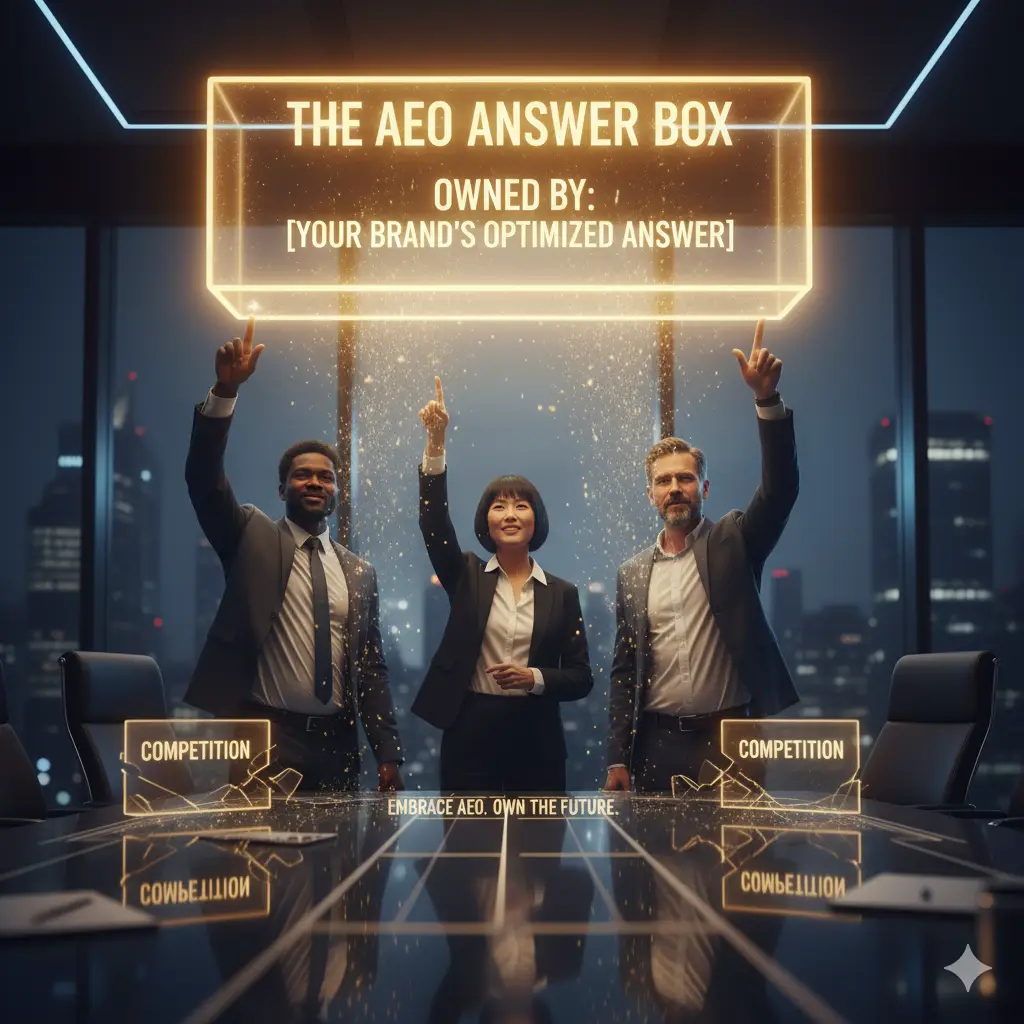
The digital marketing playbook has flipped. Just months ago, ranking on page one of Google felt like winning. But today? Brands are being evaluated not just on ranking — but on being chosen by AI-powered answer engines (chatbots, voice assistants, AI overviews). That shift is real. It’s measurable. And if you’re not prepared, you’ll be invisible even if your SEO looks perfect. A recent article from WebProNews reports that content with proper schema and answer-ready structure is seeing up to 214% boost in AI visibility as AI systems prioritise structured, machine-readable content. What’s Changed (and Fast) Reports show that as of October 2025, many businesses offering “AEO services” have launched — for example, DigitalBiz Limited launched “AI EngineBoost” to help e-commerce brands optimise for AEO and AI-powered discovery. Industry commentary (e.g., in Powersports Business) now treats AEO as not a future trend, but a current requirement: if your business hasn’t adopted AEO yet, you’re already behind. Interviews with thought-leaders (such as Aja Frost) emphasise that visibility, not traffic, is the new metric: “Are AI systems citing your brand? Are you appearing in AI summaries?” These aren’t small tweaks — they’re a structural shift in how brands are found, trusted, and chosen. Why This Matters for Brands Now 1. Zero-Click & AI-First Discovery Are Accelerating According to research, a noteworthy percentage of searches now end within the AI interface — without clicking through to a traditional link. This means that even if you rank #1 for a keyword, if your content doesn’t align with how AI selects and cites answers, it may never be surfaced. 2. Traditional SEO + Content Strategy Isn’t Enough SEO still matters — but it’s no longer the full strategy. AEO adds another layer: structuring content so AI systems can easily use it (structured data, concise answers, entity clarity). Brands that ignore this will see traffic drop or flat while competitors secure the “answer slots.” 3. Brand Presence & Trust Are Being Re-Engineered When an AI assistant says: “Here’s the answer from Brand X”, it’s creating brand trust even before a user clicks or interacts. Being cited matters. Structured data + authorship + credibility matter. If your brand isn’t set up for that, you’re missing more than clicks — you’re missing perception. 4. The Opportunity Window Is Still Open — But Closing Since the mechanics and signals of AEO are newer, brands that move now have a first-mover advantage. But many are already catching up. The brands that wait become the options, not the chosen answer. Latest 2025 Trends in AEO Here are the key trends shaping AEO right now, backed by recent sources: Structured Q&A + Schema Matter More Than Ever Content that uses FAQ blocks, HowTo schema, entity markup is being cited by AI at much higher rates. Example: Content with schema sees significantly higher “AI citation” visibility. Topic Clusters & Intent-Driven Content Replace Keyword-Only Pages Rather than one-off keyword-optimised posts, the winning brands are grouping content into topic clusters, aligning closely to user questions and intents. LLM (Large Language Model) Optimisation Becomes a Separate Function Brands are now optimising for how large language models (like ChatGPT, Gemini, Claude) parse and use content for answers — not just for search engines. Voice + Multimodal Search (Audio/Visual) Is Rising Optimising for spoken queries, voice assistants, even image-based discovery is relevant. Natural language queries are longer, more conversational. ROI and Visibility Metrics Are Changing Instead of measuring just clicks and rankings, marketers are now tracking: “How often are we cited by AI?” “Which queries is our brand appearing in?” Tools that track AI visibility are now emerging. Hybrid Human + AI Content Wins AI-generated content alone is no longer enough. The brands doing well combine human oversight (credibility, creativity) with AI efficiency (scaling, structuring) to satisfy both audiences and machines. What You Should Do Immediately? Here’s a no-fluff action list to make your brand prepared for the AEO era: 1. Audit your content for “answer readiness” — we’d help you with that for free, right here. 2. Reformat your high-value pages 3. Build topic clusters around key themes 4. Strengthen your brand signals 5. Monitor AI visibility 6. Stay agile and update content continuously Why Your Brand Should Lead — Not Follow In this shift, being early matters. If your brand optimises for AEO now, you become the default answer. If you wait, you’re chasing the authority someone else already built. Think of it this way: Ranking #1 for a keyword is great — but being cited as the answer in a voice assistant or AI chat is far more powerful. That’s where brand visibility, trust and conversions are going. Your competitors are already moving. The platforms are already evolving. The question is: Will your brand be the one providing the answer now — or will you be the one trying to catch up later? Final Thoughts The landscape of discovery has changed. Search no longer equals clicks. Answers do. AEO is not some optional marketing tweak — it’s the foundation of brand visibility in the AI-first era. If you act now, your brand can secure the answer space in your niche and shape how customers discover you. If you don’t… you risk being invisible in the moments when users expect you to be relevant. Let GoxygenAI help you be the answer. Don’t wait to become one. Expectedly, up to 95% of people would just read and nod and hope that some day they’d start. I’m sure you’re not one of them. Be part of the less than 5% of the population that actually take action immediately. If you want to be ahead, start with your free audit here.
There’s a shift happening quietly in the digital world right now. A shift so big that most brands, agencies, and creators haven’t even realised they’re already behind. And I don’t blame them. Because what’s happening now is not something Google announced publicly or something Meta shouted about. It’s not even something the average “SEO expert” understands yet. But those who understand it… are eating. And what exactly is that shift? It’s simple:AI is no longer “showing” answers — AI is becoming the answer. And that means your content must now be written for two audiences at the same time:the humans who read it… and the machines that decide whether anyone will ever see it. That’s where AEO — Answer Engine Optimization — was born. That’s the new street where all the traffic is flowing now. But something deeper is happening underneath the surface of this AEO wave. Something bigger, quieter, more powerful. Generative engines — like ChatGPT, Claude, Gemini — are no longer just “responding”.They are choosing which voices to echo. That means one thing:If your brand’s voice doesn’t become a favourite source for these engines, you’ll be invisible in a world where AI is the new search. I’ll put it simply:AEO is the key that opens the door, but GEO is the engine that drives the car.And if you’re not playing both games right now, you’re leaving the future to someone else. I’ll explain. Right now, AI engines are pulling answers from content that sounds authoritative, structured, clear, and reliable. They are scanning the web like a hungry student looking for lecture notes before exam day. And they’re choosing the content that is easiest to digest, easiest to trust, and easiest to summarise. Meaning if your content is messy, vague, noisy, or written with the goal of only impressing humans, you’re out. But when your content is built with both clarity and depth… AI naturally gravitates toward it.And when AI gravitates toward you, you stop chasing traffic. Traffic starts chasing you. That’s the real shift. This is why the brands who understand AEO today will hold the advantage everyone else will start begging for in the next 12 months. Because here’s what most people still don’t get: To win AI visibility today, you must be both the short answer and the deep source.The quick “here’s what you’re asking for” and the rich “here’s the full system behind it”. It’s almost like writing a punchline and a textbook and making them shake hands politely. And yes, it’s more work.But it’s also the easiest way to dominate this new era before everyone else wakes up. Imagine you’re standing in a room with a thousand people. All shouting. All desperate to be heard. All trying to convince the AI to pick them. But while they’re shouting, you’re the one person who’s speaking calmly, clearly, directly — with the answers structured in a way the machine understands perfectly. Guess who the machine will listen to? That’s AEO. And then imagine that same machine checking, “But who really understands this topic deeply? Who has built the most well-connected, well-structured, reliable explanation I can trust?”And it sees your long-form content, your contextual examples, your personal stories, your explanations that flow.Guess who it picks as the best source? That’s GEO. Now imagine being chosen for both. That’s what this new era requires. And it’s exactly what I’ve been architecting at GoxygenAI — content systems that don’t just rank, don’t just impress humans, but become the reference material that AI engines lean on when they are answering millions of questions. It’s the difference between being on the internet and being used by the internet.Between writing content for views and writing content that fuels the future. And once you see this shift, you can’t unsee it. So yes, 2025 isn’t the year to write “cute content” or “viral content” or “SEO content”.It’s the year to write answer content.Content that speaks at the surface level and the structural level.Content that teaches, explains, simplifies, guides.Content that an AI will proudly reference when someone asks a question at 2AM. Because that’s the new game:Visibility is for websites.Authority is for answers. And answers are the new currency. And if you want to play in that league — truly play at the top — then you need a system. A clear, deliberate, well-structured AEO + GEO engine powering your brand.Otherwise you’ll be trapped in the old world where you’re still counting impressions like someone counting coins in a cashless economy. The future is simple:The brands that become the answer will own the audience.The brands that don’t… will be asking the questions. Let GoxygenAI help you become the answer that owns the audience. “Your own procrastination” is a highly welcomed move — for your competitors. Schedule a free call now.